How much do automated gates actually cost?
It’s a sensible question, and a surprisingly hard one to answer online — many companies avoid publishing prices at all, and others advertise unrealistic “from” figures that bear little resemblance to a finished project. We take a different approach: honest bands, published in the open, and a clear account of what moves the number.
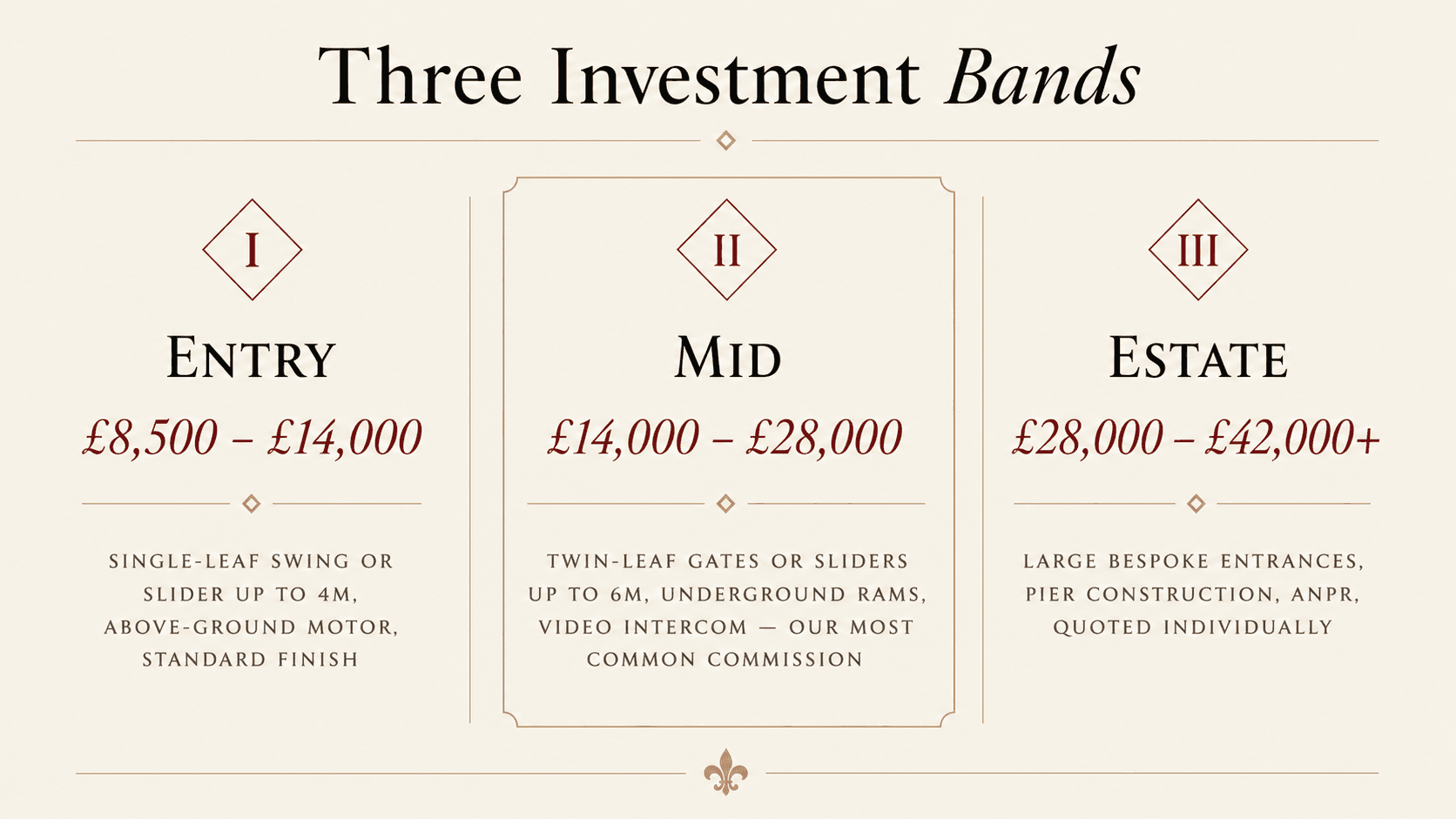
Most projects fall into one of three bands.
These are complete installed systems, accurate to within about 10% for standard specifications — not just the cost of the gate itself. Every project includes:
The full band breakdown, with everything always included, is on our investment page.
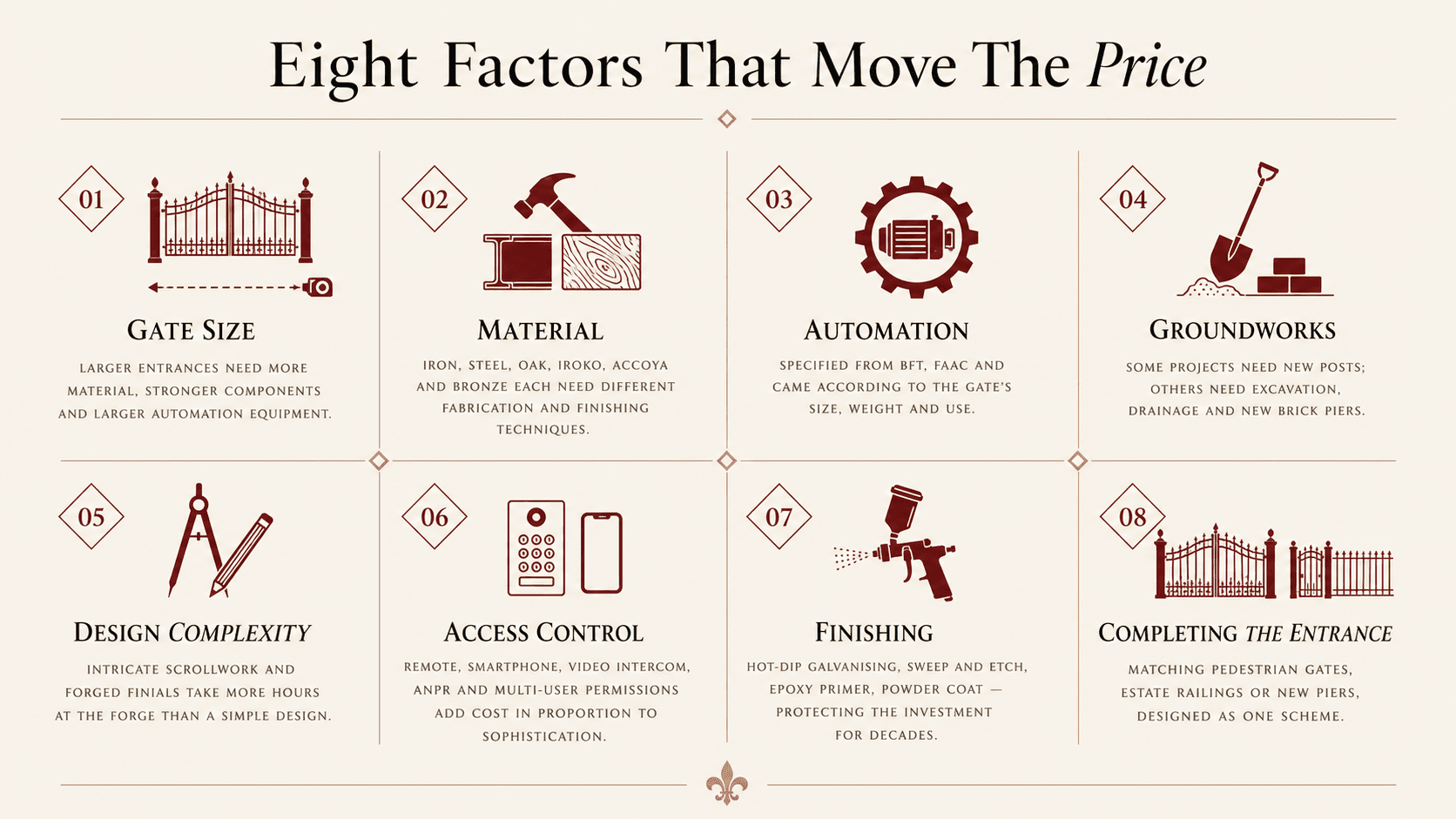
No two quotations are the same.
Instead of pricing from a catalogue, every project is built around your specific entrance. These are the factors with the greatest influence — the full figures (per-leaf and per-pier costs included) are in our cost chapter.
Gate size
Larger entrances need more material, stronger structural components and larger automation equipment. A five-metre entrance requires considerably more engineering than a three-metre one, and wider gates may need heavier foundations.
Material
Wrought iron, mild steel, English oak, iroko, Accoya® and bronze each require different fabrication and finishing techniques. Choosing the right one is a balance of appearance, durability, maintenance and budget.
Automation
Every installation is specified from BFT, FAAC and CAME according to the gate's size, weight and use. Underground operators, higher-duty motors and additional access control all move the price.
Groundworks
Some projects need little more than new gate posts; others need excavation, new foundations, drainage, ducting and new brick piers. Site-specific work is often the single biggest swing factor.
Design complexity
A simple contemporary design takes fewer fabrication hours than an intricate wrought iron gate with handcrafted scrollwork and forged finials. Because every gate is made to order, complexity translates directly into time at the forge.
Access control
Remote controls, smartphone access, video intercom, wireless keypads, ANPR and multi-user permissions all add convenience — and cost — in proportion to how sophisticated the system needs to be.
Finishing
Every metal gate goes through the four-stage process — hot-dip galvanising, sweep and etch, epoxy primer, powder coat — protecting the investment against the British climate for decades.
Completing the entrance
Many clients add a matching pedestrian gate, estate railings or new piers, designed as one scheme rather than bolted on later.
How the bands play out in practice.
All four are from our completed projects — real specifications, not estimates.
Retaining the existing brick piers let more of the budget go into the metalwork and a video intercom — the textbook Entry-band project.
A wide contemporary entrance designed around clean architectural lines — restraint carrying as much presence as ornament.
A cantilever system let the gate disappear into the garden wall when open, with no ground track to interrupt the driveway surface.
Estate gates hung from hand-built brick piers, with number-plate recognition for a large private drive — a full Estate-band specification.
A lower budget doesn’t have to mean lower quality.
There are often practical ways to bring the price down without touching the standard of the work:
The aim is never to reduce quality — it’s to invest the budget where it delivers the greatest long-term value.
Two quotes can look similar and mean very different things.
When comparing quotations, remember that not every gate is built to the same standard. Two projects can look alike on paper while differing significantly in materials, corrosion protection, automation equipment, safety systems, installation quality and aftercare. A lower figure may simply mean a lower specification.
Not “which gate is cheapest?” — but which one offers the best value over the next thirty years.
Why do automated gates cost more than manual gates?+
Because you're buying far more than the gate. Automation equipment, safety systems, electrical work, commissioning and force testing to BS EN 13241 all form part of the project, not an optional extra.
Can I automate my existing gate?+
Sometimes — the structure needs to be sound enough to accept automation safely. A site survey assesses hinge condition, leaf weight and pier stability, and we'll tell you honestly if it isn't suitable.
Do underground motors cost more?+
Yes, generally — around £800 to £1,400 more per leaf than an above-ground operator, including the groundwork. The trade-off is a completely concealed installation.
Is a sliding gate more expensive than a swing gate?+
Not inherently. Width, material and specification usually matter far more than the opening method — see our full comparison in the swing vs sliding guide.
Do you offer fixed quotations?+
Yes. Following a site survey, we prepare a detailed fixed-price quotation, valid for 90 days, setting out exactly what's included.