Swing vs sliding gates: which is right for your property?
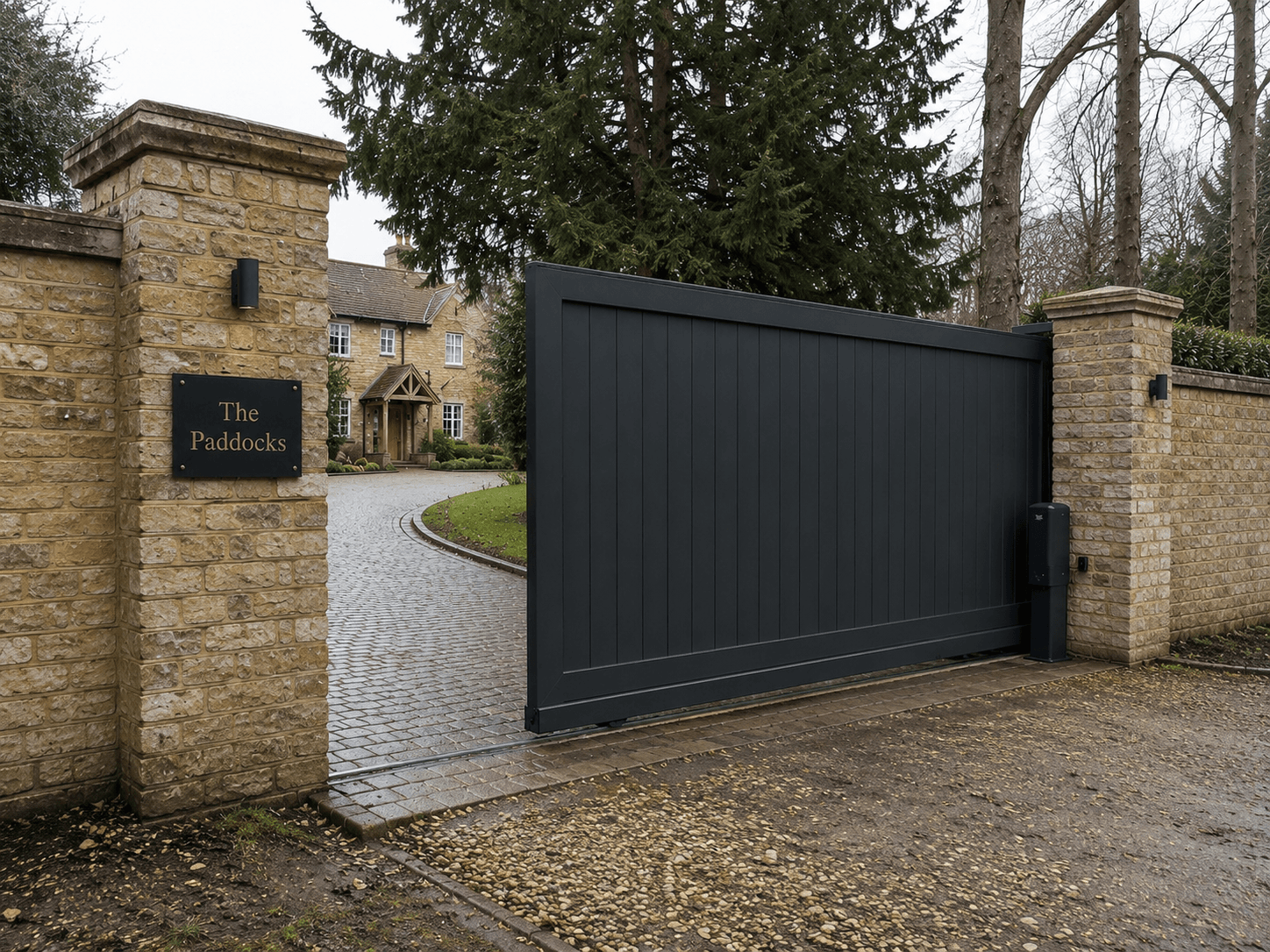
Both systems offer outstanding security, convenience and kerb appeal — but they solve the problem in very different ways. The right choice depends less on preference and more on the layout of your property, the space available and how you use the driveway every day. It’s one of the first things we assess at every site survey, before any design work begins.
The classic country-house entrance.
Swing gates open on hinges fitted to gate posts or brick piers, much like a pair of traditional doors — as a single leaf or a pair meeting in the centre. Their balanced proportions suit period properties, farmhouses and detached family homes especially well, and they can be manufactured in wrought iron, mild steel or timber to fit almost any architectural style.
Automation is provided by an underground motor concealed beneath the gate, or an above-ground operator mounted on the rear — the same two categories covered in full in our automation chapter. Where appearance matters most, underground automation keeps the gate itself the focal point.
The full range of swing gate designs, arch profiles and materials is covered in our types chapter.
Built for the site that won’t take a swing.
Instead of opening on hinges, a sliding gate travels sideways along the boundary — trading the space needed behind the entrance for space needed alongside it. That makes sliding gates a natural fit for shorter driveways, wider openings, and contemporary homes where the clean horizontal line suits the architecture.
A tracked slider runs on a ground-mounted rail; where gravel, uneven ground or debris rule that out, a cantilever gate is carried above the drive on a counterbalanced support instead, touching nothing at ground level. We fit gearmotors from CAME and BFT sized to the weight of the leaf — the specifics are in the automation chapter, and the full tracked-vs-cantilever comparison is in the types chapter.
Usually the deciding factor.
Neither system needs less space overall — it simply needs it somewhere different. A swing gate needs clear ground inside the property for the leaves to open across; a sliding gate needs a clear run alongside the entrance, roughly equal to the width of the gate itself. A short driveway close to the road often rules out swing gates before any other consideration comes into play — which is exactly why every project starts with a site survey rather than a choice from a catalogue.
Width and automation matter more than the type.
Neither type is inherently cheaper. A short single-leaf swing and a short tracked slider land in similar territory; it’s the width of the opening, the material and the automation that move a project between bands — underground rams add £800–£1,400 per leaf over an above-ground motor, and a cantilever system typically costs more than a tracked slider. The full breakdown of what moves the price is in our cost chapter.
Same brief, different site.
A long, level drive with room to spare behind the piers — the ideal case for a swing gate. Underground automation kept the Tudor-revival ironwork as the sole focal point of the entrance. See the full Knebworth case study.
A wide opening close to the house, where the brief was for the gate to disappear into the garden wall when open. A cantilever system removed the need for a ground track entirely, keeping the drive clean in every season.
Both are low maintenance — differently.
Neither type demands much upkeep with annual servicing. A tracked slider benefits from keeping the ground rail clear of leaves and gravel; a cantilever gate sidesteps that concern entirely. Swing gates have no track to maintain, but hinge condition and pier alignment are worth checking every year regardless. The full service programme — what's inspected, and our published plan prices — is in the servicing chapter.
Which is more secure, swing or sliding?+
Both provide excellent security when properly designed, built and installed. Security depends far more on the quality of the gate, the automation and the access control than on whether it swings or slides — though sliding gates, engaging their track or cantilever support along the full width of travel, are generally regarded as harder to force.
Can a sliding gate be fitted on a slope?+
Yes, more easily than a swing gate. A tracked slider needs a level run for the track itself, but a cantilever slider — carried above the ground rather than on it — copes well with sloping or uneven driveways where a swing gate would need levelling work first.
Do sliding gates need more maintenance than swing gates?+
Both are low maintenance with annual servicing. A tracked slider benefits from keeping the ground track clear of leaves and debris; a cantilever slider avoids that concern entirely, at a higher initial cost. Swing gates have no track to maintain, but hinge and pier alignment should still be checked yearly.
Is one type cheaper than the other?+
Not inherently — width, material and automation move the price far more than the choice between swing and sliding. A short single-leaf swing and a short tracked slider land in similar territory; it's wide sliders, cantilever systems and underground motors that push a project into the higher bands.
Can I convert a swing gate to sliding, or vice versa?+
Usually not without starting again — the piers, foundations and side clearance each system needs are different. It's one of the first things assessed at the site survey, which is why the decision is made before any drawing begins rather than after.