Wrought iron gates: the complete guide.
Our materials chapter covers wrought iron alongside steel, oak, iroko, Accoya and bronze — a good starting point if you haven’t settled on a material yet. This page goes deeper into iron specifically: how it’s actually forged, what it costs against mild steel, and four real gates we’ve built in it.
Six weeks at the forge — before it ever reaches your drive.
Wrought iron gates aren’t assembled from a parts catalogue. Every one starts as a drawing and ends as a hand-forged structure, and the process in between is what separates a gate that looks hand-forged from one that actually is.
The drawing wall
Before a single bar is cut, the design is drawn full-scale in pencil — on the workshop wall itself, not just on paper. Proportions, curves and finial positions are checked at true size, where a mistake is obvious, rather than scaled up from a small sketch and discovered too late.
Forging the ironwork
Bar stock is heated and hammered to shape by hand — scrollwork curled, finials drawn out, collars formed to join the scrolls to the frame. A typical twin-leaf gate spends around six weeks at the forge: every bar, ring and finial made individually, not stamped from a die.
Assembly and structure
The frame is assembled and the forged detail fitted to it, checked continually against the full-scale drawing from stage one. Structural joints are welded for strength; decorative collars and rings are fitted in the traditional manner, so the visible joinery still reads as forged work rather than a fabricated frame with ornament bolted on.
Finishing
The finished gate goes through the same four-stage protective process as every metal gate we make — hot-dip galvanising, sweep and etch, epoxy primer, powder coat — described in full in the materials chapter. This is what gives a hand-forged gate a service life measured in decades rather than years.
Not a quality question — a character question.
Mild steel isn’t a cheaper substitute for wrought iron — it’s a different, equally legitimate material, finished to the same standard and lasting just as well. The real difference is in the making: wrought iron is built up from individually forged, hand-worked detail, which is why it costs 30–40% more and why it suits a period or listed property especially well. Mild steel fabricates faster, so it usually makes more sense for a contemporary design, or where the budget is better spent elsewhere.
On our published price bands, wrought iron typically places a project in the Mid or Estate band — twin-leaf hand-forged gates start to appear from the Mid band upward, and hand-forged estate ironwork is one of the defining features of the Estate band.
What we’ve actually forged.
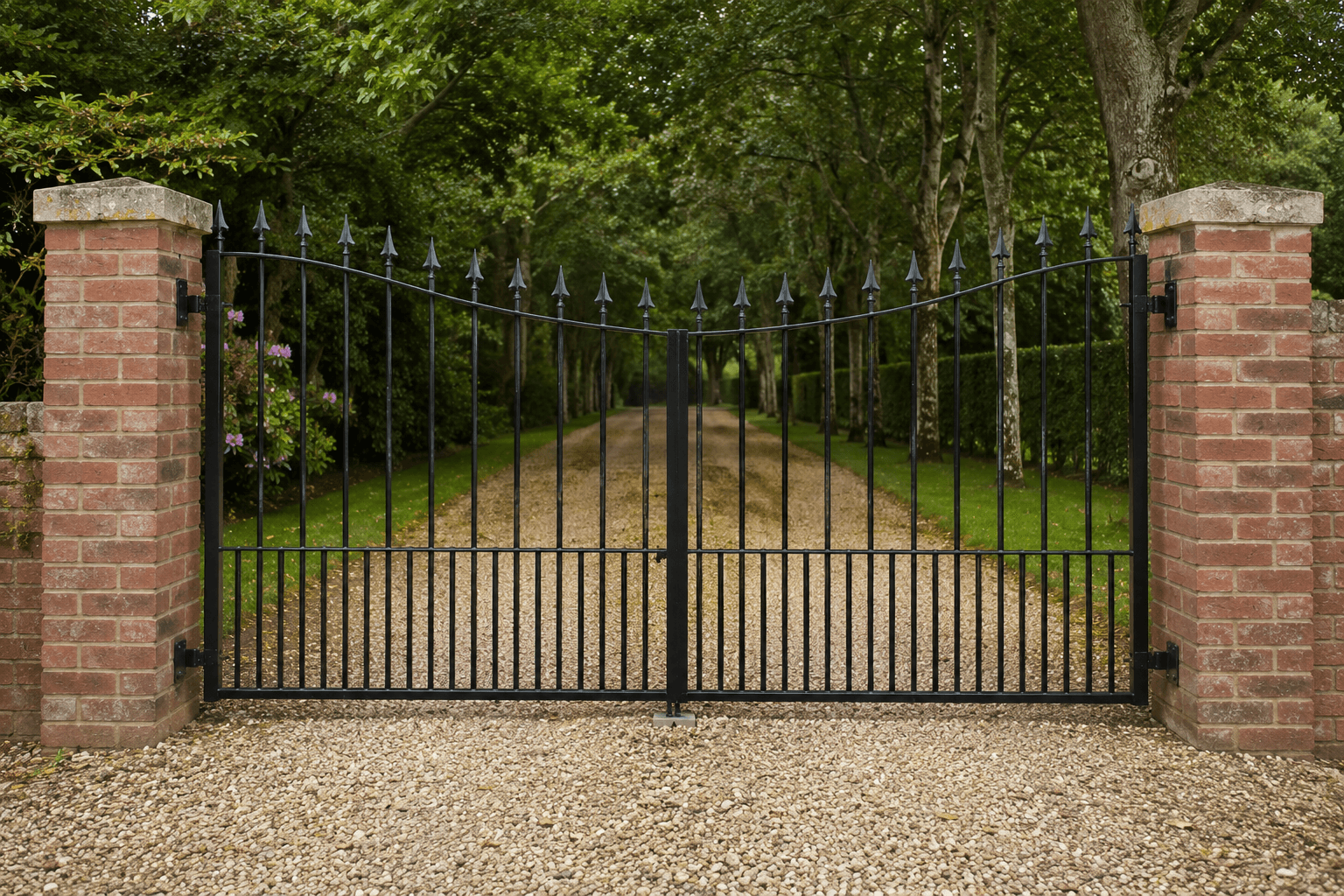
Gothic arches and fleur-de-lis finials, matched to the proportions of an Edwardian house. Hand-built brick piers in Flemish bond. Read the full case study. Read the full case study →
A private estate entrance hung from hand-built brick piers, with number-plate recognition for a large drive — full Estate-band specification.
Wrought iron framing with solid oak privacy panels — a common combination where the client wants the character of iron and the seclusion of a solid gate.
A faithful replica of the property's original Edwardian ironwork, forged from scratch after the originals were lost — proof that period detail can be recreated, not just approximated.
Seventy years starts with one habit.
The four-stage finish does most of the work, but one thing genuinely matters for longevity: touching up chips and scratches before rust has a chance to take hold underneath the paint. A galvanised gate resists corrosion structurally, but a bare patch left through a winter is how surface rust eventually gets started.
All of this is folded into the annual service visit described in our servicing chapter— it isn’t a separate job you need to arrange yourself.
How long does a wrought iron gate last?+
Properly manufactured and finished, 70 years or more with appropriate care — the metal itself will outlast several generations of automation equipment fitted to it.
Will it rust?+
Not if finished correctly. Every metal gate is hot-dip galvanised at 450°C before being powder-coated, which protects the steel from beneath the paint layer, not just on top of it. Surface chips should be touched up promptly — that's the one real maintenance task.
Is it heavier than mild steel, and does that matter?+
The finished weight is broadly comparable for the same design — it's the fabrication technique, not the density of the metal, that differs. Automation is always specified to the actual weight of the leaf, whichever material it's made from, so this isn't something you need to plan around yourself.
Can you match or restore existing ironwork?+
Usually, yes — we’ve forged a faithful replica of lost Edwardian ironwork before (see the Colchester project below). Bring photographs to the site visit and we’ll tell you honestly whether a match is achievable.
Can a wrought iron gate be any colour?+
Any RAL shade, in satin or matt, as part of the standard four-stage finish. Metallic or specialist finishes carry a small supplement, covered in our cost guide.